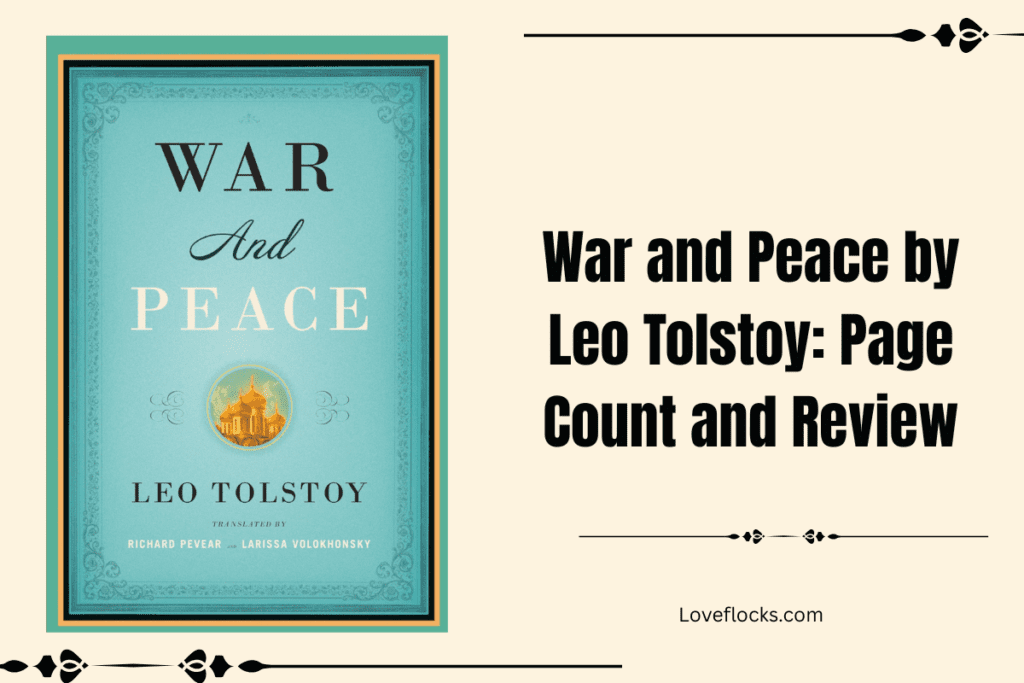
War and Peace by Leo Tolstoy is widely regarded as one of the greatest novels ever written, a monumental work of literature that blends historical events, philosophical insights, and deeply human storytelling. The novel follows multiple families against the backdrop of the Napoleonic Wars, exploring themes of love, honor, fate, and the search for meaning in a turbulent world. Its epic scope and intricate character development make it both challenging and profoundly rewarding to read.
The length of the book—typically over 1,200 pages in most English editions—can feel daunting, but every page contributes to the immersive experience Tolstoy intended. Readers are drawn not only into the historical conflicts but also into the inner lives of his characters, making the novel a journey through both society and the human soul.
Book Relevance
War and Peace remains profoundly relevant today because it explores timeless themes that resonate with readers across generations. At its core, the novel examines the human condition—love, loss, ambition, fear, and the search for meaning—set against the backdrop of historical upheaval. The personal struggles of Tolstoy’s characters mirror challenges that individuals continue to face in modern life, from moral dilemmas to the tension between personal desires and societal expectations.
The novel also provides valuable insights into history, particularly the Napoleonic Wars and Russian society of the 19th century. Understanding these events helps readers appreciate how large-scale social and political forces shape personal lives and human behavior. Tolstoy’s attention to historical detail and his philosophical reflections offer lessons on leadership, ethics, and the impact of war on society—lessons that are still pertinent in today’s world.
Beyond history and philosophy, War and Peace encourages deep emotional intelligence. Readers are invited to empathize with a vast array of characters, experiencing their joys, sorrows, fears, and triumphs. This immersive character study fosters self-reflection, compassion, and a broader understanding of human motivations, making the novel a timeless guide to navigating complex social and emotional landscapes.
Finally, the book’s relevance is reinforced by its literary influence. Countless authors, filmmakers, and thinkers have drawn inspiration from Tolstoy’s epic, using its themes, narrative techniques, and philosophical depth to enrich their own works. Engaging with War and Peace is not just reading a story—it is participating in a centuries-long conversation about life, morality, and the human spirit.
How many pages are in the novel War and Peace
Page count: why it varies — and typical ranges
There is no single page count for War and Peace — it varies significantly depending on translation, formatting, font size, publisher, and whether the edition includes introductions/notes/appendices.
Most modern English‑language print editions fall roughly in the range of about 1,200 to 1,400 pages.
Some paperback printings may be a bit shorter (tighter font/spacing); others may be longer (larger print, footnotes, extra historical/contextual material).
The original Russian edition, when first published, reportedly ran “over 1,200 pages.”
Bottom line: expect roughly around 1,200–1,400 pages in a standard print edition; always check the edition details before buying so you know what you’re getting.
What the length means for you (reader’s perspective, pros & cons)
Pros:
Epic scope & richness: The large page count gives space for deep character development, interwoven family sagas, historical context (especially around the Napoleonic wars), philosophical reflections, and immersive detail. Many readers consider this a key part of its greatness.
Value for money & longevity: A single copy will give you a multi‑volume feel in one book; if you read slowly, this becomes a “long-term companion”.
Depth of setting: Because Tolstoy doesn’t rush—he describes interior life, societal pressure, war strategy, and family dynamics—you get a vivid, layered portrayal of 19th‑century Russia, with moral, historical, personal, and existential weight.
Cons / What to plan for:
Time commitment: It’s a long read. Finishing it requires patience and commitment.
Sometimes dense/challenging: The volume of characters and subplots, plus philosophical digressions, can feel heavy, especially at the start. Some readers find the first 10–20% slow.
Physical size (if print): As a large book, some print editions can be heavy or less portable than slim novels.
So reading War and Peace is more like embarking on a journey than casually picking up a novel — but many regard it as worth every page.
Recommended Editions to Consider Buying
If you decide to purchase War and Peace, here are a few editions often recommended for their translation quality, readability, and completeness:
War and Peace by Leo Tolstoy (Penguin Classics) — A widely available, respected edition; solid balance between readability and completeness.
War and Peace: Modern Library Classics Edition — Often chosen by serious readers for a durable hardcover and a smooth translation; a good choice if you want a lasting copy.
War and Peace: Oxford World’s Classics Edition — Another reputable edition, sometimes preferred for footnotes, historical context, and for readers who appreciate clarity in older‑world settings.
If you prefer reading on a device (tablet/Kindle) to lighten the physical burden, digital versions are often easier to carry — but page counts become fluid due to screen size and font adjustments.
My Recommendation (If I Were You)
If I were choosing War and Peace now, I’d go for a well‑formatted hardcover or a good paperback (like Penguin or Modern Library) — that ensures the text is complete, the layout is readable, and the book is durable. I’d treat it as a long‑term reading project, maybe reading in parts (e.g., a few dozen pages per day), to enjoy the depth without burning out.
If you want, I can list 5–10 of the best editions worldwide (with page counts, print size, translation, and price range) to help you pick the one that suits your reading style.
Do you want me to build that list now?
War and Peace by Leo Tolstoy is famous not only for its length but also for its vast cast of characters. While exact counts can vary depending on how minor characters are counted, here’s a clear breakdown:
Main Characters
Tolstoy focuses on a core group of families and individuals, including:
Pierre Bezukhov – The introspective, idealistic heir who struggles with purpose.
Prince Andrei Bolkonsky – Nobleman, war hero, and contemplative thinker.
Natasha Rostova – Young, passionate, and emotionally complex member of the Rostov family.
Count Ilya Rostov – Father of the Rostov family.
Maria Bolkonskaya (Princess Marya) – Devout and dutiful daughter of the Bolkonsky family.
Helene Kuragina – Pierre’s wife, known for her beauty and social ambition.
Anatole Kuragin – Helene’s brother, reckless and charming.
There are around 15–20 major characters who drive the primary narrative arcs.
Supporting and Minor Characters
Tolstoy populates his world with:
Soldiers, officers, and generals (e.g., Kutuzov, Napoleon, and Prince Bagration).
Servants, peasants, and townspeople.
Extended family members, social acquaintances, and secondary aristocrats.
Counting all named individuals, the novel has over 500 characters in total. Many appear briefly, but each contributes to Tolstoy’s portrayal of Russian society, war, and human behavior.
Why the Large Cast Matters
It creates a realistic, multi-dimensional world, reflecting the complexity of society.
It allows Tolstoy to explore multiple perspectives on war, peace, love, and morality.
It challenges readers to track relationships and events but also rewards them with a rich, immersive experience.
Quick review of War and Peace in Biblical Perspective, [current_date]
Epic narrative and historical depth
War and Peace presents history and fiction in a seamless tapestry, combining the Napoleonic Wars with the intimate lives of families. Tolstoy’s attention to historical detail brings the era vividly to life while exploring universal human experiences.
Proverbs 16:3 – “Commit to the Lord whatever you do, and he will establish your plans.”
Through its historical layers, the novel reminds us that human choices and divine providence intersect in shaping life’s outcomes.
Complex and memorable characters
The novel’s characters, from Pierre Bezukhov to Natasha Rostova, are multi-dimensional, full of inner conflicts, growth, and profound emotional depth, making them relatable across centuries.
Jeremiah 29:11 – “For I know the plans I have for you,” declares the Lord.
Tolstoy shows that character development is a reflection of the journey each person undertakes toward purpose and meaning.
Philosophical insights on life and war
The narrative frequently pauses to reflect on human existence, free will, history, and morality, offering timeless wisdom that remains relevant to readers today.
Ecclesiastes 3:1 – “There is a time for everything, and a season for every activity under the heavens.”
These philosophical interludes encourage readers to contemplate life’s larger purpose amidst personal and societal struggles.
Family and societal dynamics
Through the Rostovs, Bolkonskys, and Kuragins, Tolstoy explores family relationships, societal expectations, and the pressures of status and duty, offering a mirror of human society.
Colossians 3:20 – “Children, obey your parents in everything, for this pleases the Lord.”
Family and societal structures are portrayed with realism, showing both their challenges and enduring bonds.
The human experience of love
Love, in all its forms—romantic, familial, and platonic—is central to the narrative, revealing both joy and sorrow as characters navigate their relationships in turbulent times.
1 Corinthians 13:4-5 – “Love is patient, love is kind… it does not delight in evil but rejoices with the truth.”
Tolstoy illustrates that love shapes decisions, resilience, and personal growth.
Psychological realism
The novel delves deeply into characters’ internal struggles, portraying thoughts, fears, and moral dilemmas with psychological insight that was ahead of its time.
Psalm 139:23-24 – “Search me, God, and know my heart.”
This psychological depth allows readers to connect intimately with the characters’ inner journeys.
War and its impact
Through vivid battle scenes and strategic descriptions, Tolstoy portrays the horrors, heroism, and futility of war, while highlighting its effect on ordinary lives.
Isaiah 2:4 – “They will beat their swords into plowshares.”
The depiction of war serves as both historical documentation and moral reflection.
Moral and ethical reflections
The book frequently challenges readers to consider questions of justice, personal responsibility, and ethical action, offering profound moral guidance within the narrative.
Micah 6:8 – “Act justly and love mercy and walk humbly with your God.”
Tolstoy emphasizes that moral integrity is essential even amid societal and personal turmoil.
Epic scope and grandeur
The sheer scale of War and Peace, with its hundreds of characters and multiple storylines, creates a sense of grandeur and immersion unparalleled in literature.
Psalm 8:3-4 – “When I consider your heavens, the work of your fingers… what is mankind that you are mindful of them?”
The expansive scope allows readers to witness the interplay of individual lives and historical forces.
Faith and spirituality
Spiritual reflection weaves through the narrative, as characters seek meaning, divine guidance, and moral clarity, emphasizing the role of faith in human experience.
Proverbs 3:5-6 – “Trust in the Lord with all your heart and lean not on your own understanding.”
Faith serves as a guide through personal trials and societal upheaval.
Narrative style and prose
Tolstoy’s prose is both descriptive and analytical, blending detailed observation with philosophical commentary, creating a literary style that is immersive and intellectually stimulating.
Psalm 19:14 – “May these words of my mouth and this meditation of my heart be pleasing in your sight.”
The style engages both the emotions and the intellect of the reader.
Interplay of fate and free will
The novel explores how history, personal choice, and fate intersect, showing that human actions are significant yet influenced by larger forces.
Proverbs 19:21 – “Many are the plans in a person’s heart, but it is the Lord’s purpose that prevails.”
Tolstoy invites readers to reflect on the balance between destiny and decision.
Timelessness and cultural relevance
Despite being set in early 19th-century Russia, the novel’s themes of love, war, morality, and society remain relevant to readers today, making it timeless literature.
Ecclesiastes 1:9 – “There is nothing new under the sun.”
The human experiences portrayed continue to resonate with modern audiences across cultures.
Literary influence and inspiration
War and Peace has inspired generations of writers, filmmakers, and thinkers, influencing storytelling techniques, historical novels, and philosophical literature worldwide.
2 Timothy 3:16 – “All Scripture is God-breathed and is useful for teaching, rebuking, correcting and training in righteousness.”
Its influence underscores the power of literature to shape thought, culture, and spiritual reflection.
Summary
War and Peace is an epic exploration of human life set against the backdrop of the Napoleonic Wars. Tolstoy masterfully intertwines personal stories with historical events, creating a vast tapestry that captures both the intimacy of individual experience and the sweeping forces of history. The novel delves deeply into themes of love, family, honor, morality, and destiny, portraying characters whose struggles, joys, and reflections resonate across centuries. Its richness lies not only in its narrative but also in the philosophical insights interwoven throughout, encouraging readers to ponder the meaning of life, the role of fate, and the nature of human choice.
At the heart of the story are the families of Pierre Bezukhov, Natasha Rostova, and Prince Andrei Bolkonsky, whose lives intersect in complex ways. Through their experiences, Tolstoy explores the emotional, moral, and social dimensions of human existence. The novel captures the essence of war—the fear, courage, loss, and unexpected heroism—while also highlighting the profound impact of peace, love, and reflection on the human spirit. This dual focus on the personal and historical makes the book a timeless study of life itself.
Finally, War and Peace endures as both a literary masterpiece and a source of spiritual and philosophical insight. Its detailed characterization, realistic depiction of Russian society, and deep moral inquiry offer lessons in empathy, resilience, and reflection. Readers are invited not merely to witness history or story but to engage with the ethical and emotional questions that Tolstoy presents, gaining both intellectual enrichment and personal inspiration. The novel’s relevance today lies in its ability to illuminate the complexities of human life while inspiring contemplation, moral growth, and a deeper understanding of our own place in the world.